Washing An Electric Car In Kensington: What Tesla, Porsche And BMW EV Owners Actually Need To Know
Drive down Kensington Road on any given weekday morning and count the electric cars. You will run out of fingers before you reach the junction at Gloucester Road. Teslas have become so commonplace in W8 that spotting a Model 3 barely registers. Taycans sit quietly in the mews. BMW iX models occupy residents’ bays outside mansion blocks like well-mannered robots waiting for instructions. Kensington has, without much fanfare, become one of the most electrified postcodes in the country.
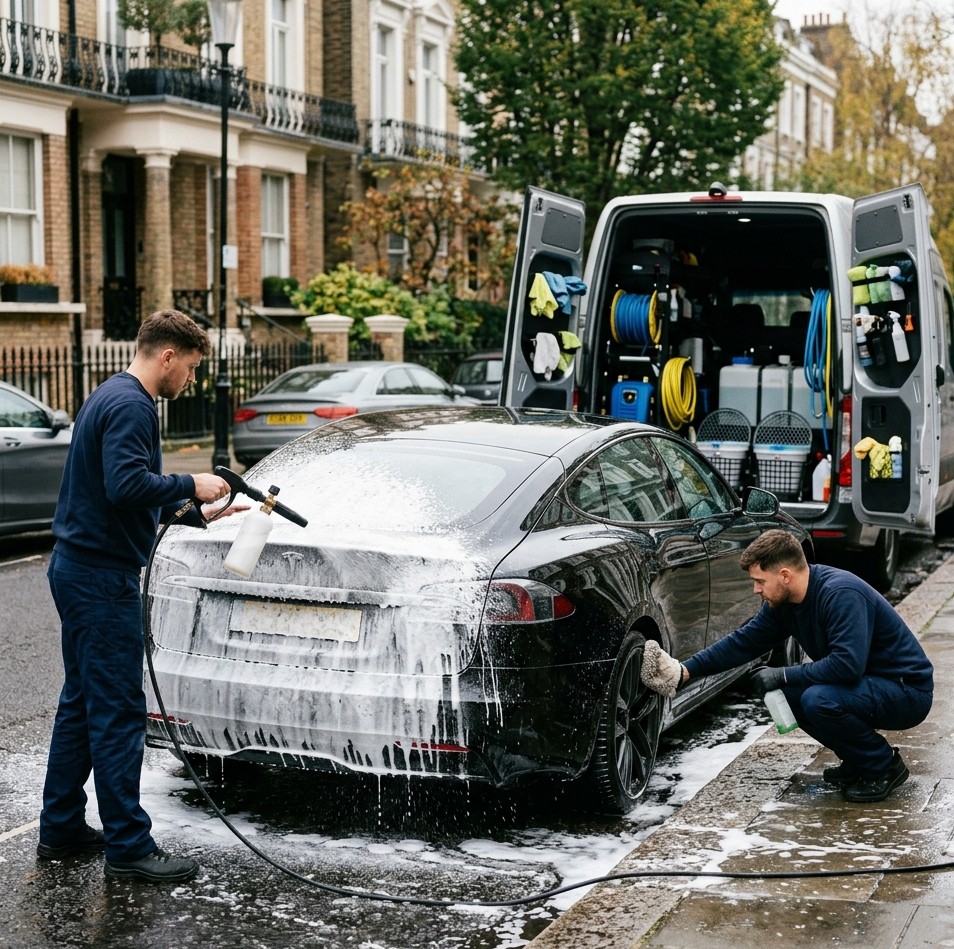
What has not kept pace is the practical advice available to EV owners about how to look after these cars – specifically, how to wash them. The questions I get asked most often cluster around the same anxieties: is it safe to use water near the battery? Will a pressure washer cause damage? Can I just run it through an automatic wash? The short answer to all three is: it depends, and the details genuinely matter. Here is what years of washing EVs on Kensington’s streets have taught me.
Electric Cars And Water – Separating Myth From Reality
What IP Ratings Actually Tell You (And What They Leave Out)
The most persistent myth about washing electric vehicles is that water and high-voltage battery packs are a dangerous combination. It is an understandable worry, but it is largely unfounded. Every modern EV sold in the UK is engineered to withstand rain, road spray, and standard car washing without any risk to the electrical system. Battery packs are sealed units built to IP67 standards or higher – meaning they can handle submersion in a metre of water for thirty minutes without issue. A rinse with a garden hose is not going to cause a crisis.
What IP ratings do not tell you is that every part of the car is equally well protected. The charging port is the obvious exception: it should always be firmly closed before washing begins, and you should avoid directing a pressure lance directly at it even when shut. Frunk drainage channels, common on Teslas, can pool water if blasted from the wrong angle. And some of the sensor housings embedded in the bumpers and grilles of newer BMWs and Porsches benefit from a gentler approach than a close-range pressure jet delivers. These components are robust, but there is little reason to test their limits unnecessarily.
The other thing IP ratings say nothing about is paint quality – and this is where brand differences matter considerably. Tesla’s paintwork, particularly on earlier Model 3 and Model Y builds, is notoriously thin. Enthusiast forums have been cataloguing this for years. It marks more easily than comparable premium cars, picks up fine scratches from automatic brush washes, and shows swirl marks badly in direct sunlight. Porsche and BMW apply paint to more traditional luxury standards, which makes them more forgiving – but neither is immune, especially around the soft-touch plastic trim elements both brands use on bumpers, door handles, and mirror housings.
There is also a software dimension that combustion-engine owners never have to think about. Tesla offers a dedicated Car Wash Mode through the touchscreen: it closes windows and vents, disables automatic wipers, and locks the charge port flap. It takes thirty seconds to activate and removes several potential complications at once. It is worth using every single time, without exception.
The Areas That Genuinely Deserve Extra Care
Charging Ports, Underbodies, And Getting Pressure Right
With the general anxiety about water addressed, it is worth looking at the specific parts of an EV where washing technique actually makes a difference.
The charging port has already been mentioned, but it deserves a closer look. On most EVs, it sits behind a spring-loaded flap that seals tightly when closed – keep it shut and you are fine. The issue arises when owners start a wash while the car is still connected to a charge point, something I encounter regularly on Kensington’s residential streets where cars are routinely trickle-charging overnight from kerbside posts. Disconnect first, close the port firmly, then proceed. It sounds obvious, but in the rush to squeeze a wash in before the school run, steps get skipped.
The underbody is a more nuanced area. Unlike conventional combustion cars, most EVs feature a flat, aerodynamically sealed panel covering the battery pack beneath the floor. From a cleaning perspective, this is actually welcome news: grime does not accumulate in the same convoluted way it does around exhausts, fuel tanks, and transmission tunnels. The flat surface washes cleanly and dries quickly. What to avoid is sustained high-pressure jetting aimed directly at the panel seams or at any visible cabling routes along the chassis. A sensible pressure from a sensible distance is entirely adequate – there is no need to get heroic about it.
One thing that genuinely surprises many EV owners: the wheels accumulate significantly less brake dust than those on petrol or diesel vehicles, because regenerative braking does the bulk of the work of slowing the car. On a Taycan or an i4 driven with strong one-pedal engagement, the physical brake discs barely activate in routine urban driving. For anyone who has spent time on their knees scrubbing iron deposits off alloys, this is genuinely welcome news. Wheel cleaning remains necessary – London’s roads see to that – but it is a considerably less punishing task on a modern EV, and the results tend to stay cleaner for longer between washes.
Why Waterless Washing Makes Particular Sense For Kensington EV Owners
The Practical And Environmental Case For Going Almost Dry
There is a pleasing logic to the fact that the cleaning method best suited to electric vehicles is also the most environmentally considerate one. Waterless washing – using specialist spray products that lift and encapsulate dirt without requiring a rinse – has become my preferred approach for a significant proportion of EV jobs in Kensington, and the reasons extend well beyond keeping the peace with the neighbours.
Practically speaking, many EV owners in this part of London do not have straightforward access to an outdoor tap. They live in mansion flats with underground parking, or in mews houses where running a hose across cobblestones is somewhere between impractical and theatrical. Waterless products eliminate that problem entirely. They work from a spray bottle and a set of microfibre cloths, require no drainage management, and leave no puddles for the building porter to raise an eyebrow at.
The results on a well-maintained EV are genuinely impressive. Because electric cars – especially those garaged underground or parked on quieter residential streets – tend to accumulate lighter surface contamination than vehicles doing heavy motorway mileage, waterless products handle the load comfortably. The smooth, aerodynamic body panels that characterise most modern EVs also respond particularly well to the method: fewer crevices and complex surfaces mean the product can be worked across large areas efficiently and evenly, without the product drying out before you have had the chance to buff it off.
There is also, it has to be said, a natural alignment between the outlook of many EV owners and the environmental credentials of waterless washing. Someone who has chosen a Taycan or an iX over a petrol equivalent tends to be reasonably engaged with their overall footprint. A process that uses a fraction of the water required by a traditional wash – and produces no chemical runoff into Kensington’s already-pressured drainage system – tends to sit well with that sensibility. It is not the only reason to choose waterless, but it is rarely a reason to reject it.
Tesla, Porsche Taycan And BMW – What’s Different About Each
Three Cars, Three Sets Of Priorities
Most of the EVs I wash in Kensington fall into one of three camps, and each comes with its own quirks and priorities from a cleaning perspective.
Tesla owners need to keep two things in mind above all: the paint and the glass. The paint situation is well documented among owners – use soft, clean microfibres, avoid anything with abrasive properties, and give automatic brush washes a wide berth if the finish matters to you. Activating Car Wash Mode before any wash is a habit worth building. The panoramic glass roof fitted to most current models is best treated with a dedicated glass product rather than an all-purpose spray – some multipurpose cleaners leave a residue that becomes genuinely distracting when low winter sun hits it at the wrong angle on the way down the Cromwell Road.
Porsche Taycan owners are generally working with better base paint quality, but the car introduces its own considerations. The front boot – shallower and more enclosed than Tesla’s frunk – can trap moisture if not dried properly after a wet wash, so it rewards careful attention. The Taycan also tends to sit lower than many EVs, which means the front splitter and side sills pick up road film efficiently in London’s stop-start traffic. These areas benefit from a dedicated traffic film remover applied before the main wash rather than hoping a general shampoo will shift what has effectively bonded to the surface.
BMW iX and i4 owners should pay particular attention to the large front grille assembly. On the iX especially, this structure houses radar and camera systems rather than serving as a traditional air intake, which means it should be cleaned carefully and kept clear of debris – but not subjected to high-pressure water directed straight at it. The iX also offers interior options including open-pore wood trim and recycled textile surfaces, both of which require specific care: the former responds badly to overly wet products, the latter to anything solvent-based.
Three cars, three different approaches – but the same underlying principle applies to all of them: understanding what you are dealing with before reaching for the first product is what separates a result worth being proud of from one you would rather not dwell on.